Max van Manen
Professor Emeritus - University of Alberta

Researching Lived Experience is an introductory text on phenomenological writing. Through detailed methodological explications and practical examples of hermeneutic phenomenological inquiry, it shows how to orient oneself to human (pedagogical) experience and how to construct a questioning inquiry which evokes a fundamental sense of wonder, and it provides a broad and systematic set of approaches for gaining experiential material. Special attention is paid to the methodological function of anecdotal narrative in human science research, and approaches are offered for structuring the phenomenological text in relation to the particular kinds of questions being studied. Finally, it is argued that the choice of research method not only is itself a pedagogical commitment, but also reveals how one stands pedagogically in life.
Also available in: Korean and Chinese.
This text is based on a human science project exploring methodological approaches for researchers interested in hermeneutic phenomenology.
To order from Althouse Press: www.uwo.ca/edu/press/vanman2.html
From the back cover:
Researching Lived Experience introduces a human science approach to research methodology in education and related professional fields such as counselling, nursing, psychology, health science. This methodology takes as its starting point the “everyday lived experience” of human beings as they find themselves in the world and as they give active shape to their world. Rather than rely on generalizations and theories in the traditional sense, the author offers an alternative that taps the unique nature of each human situation.
Researching Lived Experience offers detailed methodological explications and practical examples of hermeneutic phenomenological inquiry. It shows how to orient oneself to human experience and how to construct textual questions which evoke a fundamental sense of wonder, and it provides a broad and systematic set of approaches for gaining experiential material which forms the basis for textual reflections in the production of interpretive insights. The author also discusses the part played by language in human science research, and the importance of pursuing human science critically as an ongoing and radically reflective process. Special attention is paid to the methodological function of anecdotal narrative in human science research, and approaches are offered for structuring the research text in relation to the particular kinds of questions being studied. Finally, van Manen argues that the choice of research method is itself an ethical commitment that shows how one stands in life.
A HUMAN SCIENCE APPROACH TO RESEARCH AND WRITING:
Action Sensitive Knowledge for a Reflective Pedagogy
I. Human Science
- Why Do Human Science Research?
- What Is A Phenomenological Human Science?
- Human Science is Rational
- Problems or Questions?
- Description or Interpretation?
- Research-Procedures, Techniques, and Methods
- Methodical Structure of Human Science Research
II. Turning to the Nature of Lived Experience
- The Nature of Lived Experience
- Orienting to the Phenomenon
- Formulating the Phenomenological Question
- Explicating Assumptions and Pre-understandings
III. Investigating Experience as We Live It
- The Nature of Data (Datum: thing given or granted)
- Using Personal Experience as a Starting Point
- Tracing Etymological Sources
- Searching Idiomatic Phrases
- Obtaining Experiential Descriptions from Others
- Protocol Writing (lived experience descriptions)
- Interviewing (the personal life story)
- Observing (the experiental anecdote)
- Experiential Descriptions in Literature
- Biography as a Resource for Experiential Material
- Art as a Source of Lived Experience
- Consulting Phenomenological Literature
IV. Phenomenological Reflection
- Conducting Thematic Analysis
- Situations
- Seeking Meaning
- What Is a Theme?
- The Pedagogy of Theme
- Uncovering Thematic Aspects
- Isolating Thematic Statements
- Composing Linguistic Transformations
- Gleaning Thematic Descripts from Artistic Sources
- Interpretation through Conversation
- Collaborative Analysis:the Research Seminar/Group
- Determining Essential Themes
V. Phenomenological Writing
- Attending to the Speaking of Language
- Silence-the Limits and Power of Language
- Anecdote as a Methodological device
- The Value of Anecdotal Narrative
- Varying the Examples
- Writing Mediates Reflection and Action
- Writing is the Measure of Our Thoughtfulness
- Writing Exercises the Ability to See
- To Write is to Rewrite
VI. Maintaining a Strong and Oriented Relation
- The Relation Between Research/Writing and Pedagogy
- On the Ineffability of Pedagogy
- The Pedagogic Practice of Textuality
- Human Science as Action Research
VII. Balancing the Research Context, Parts and Whole
- The Research Proposal
- Effects and Ethics of Human Science Research
- Plan and Context of a Research Project
- Organizing Writing
- Glossary
- References
Translations:
Korean
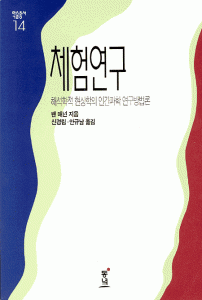
 Translated by Dr. Kyung Rim Shin
(1994)
ISBN 89-7297-341-6
(255 pages)
E-mail for Dr. Kyung Rim Shin: [email protected]
Chinese

Translated by Guangwen Song (2002) China Education Science Press.
Japanese
 Translated by Naoko Murai